If you have ever dealt with stick drift, you have probably seen people online recommending controllers with “Hall Effect vs potentiometer sticks is an important comparison when choosing a gaming controller. Hall Effect sticks use magnetic sensors, while potentiometer sticks rely on physical contact to track movement. This guide compares their durability, accuracy, drift risk, feel, and cost.” as the fix for all your problems. But what does that actually mean, and is it really that much better than the standard sticks found in most controllers? This article breaks down the real difference in plain language, backed by how these parts actually work inside your controller.
What a Potentiometer Stick Actually Is
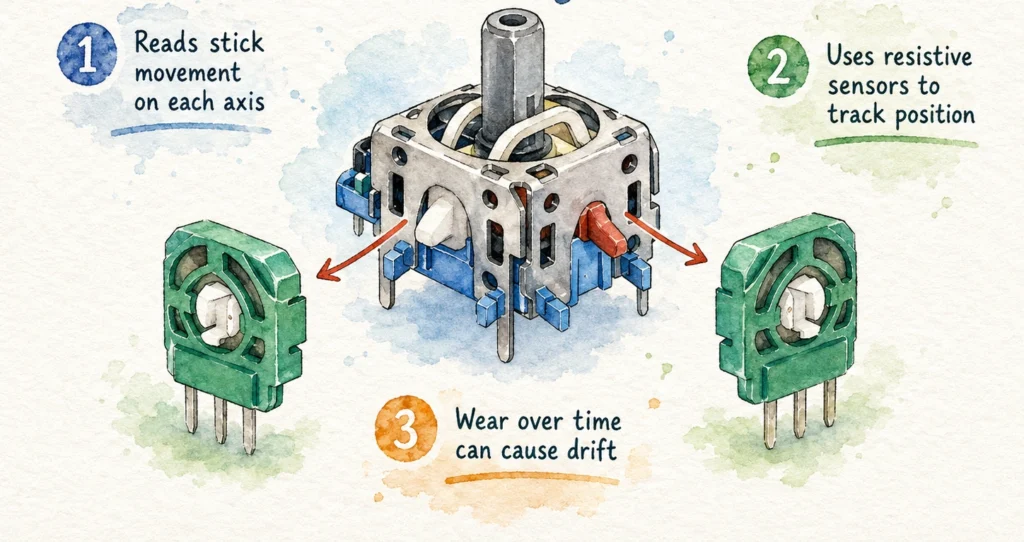
A potentiometer is the traditional part used inside most analog sticks for decades, in everything from Xbox and PlayStation controllers to Nintendo Joy Cons. It works through direct physical contact between a small wiper arm and a resistive strip.
Here is the simple version of how it works:
- The stick sits on top of a small mechanical arm
- When you move the stick, that arm slides across a strip of resistive material
- The exact position of the arm on that strip changes the electrical resistance
- The controller reads that resistance change and translates it into stick position data
| Part of the Process | What Happens |
|---|---|
| Stick movement | Physically moves the internal wiper arm |
| Wiper arm sliding | Rubs directly against a resistive strip |
| Resistance change | Electrical signal changes based on wiper position |
| Signal sent to console | Console interprets this as stick direction and distance |
The key detail here is physical contact. The wiper arm is always touching the resistive strip, and that constant rubbing is exactly why potentiometers wear out over time.
What a Hall Effect Stick Actually Is
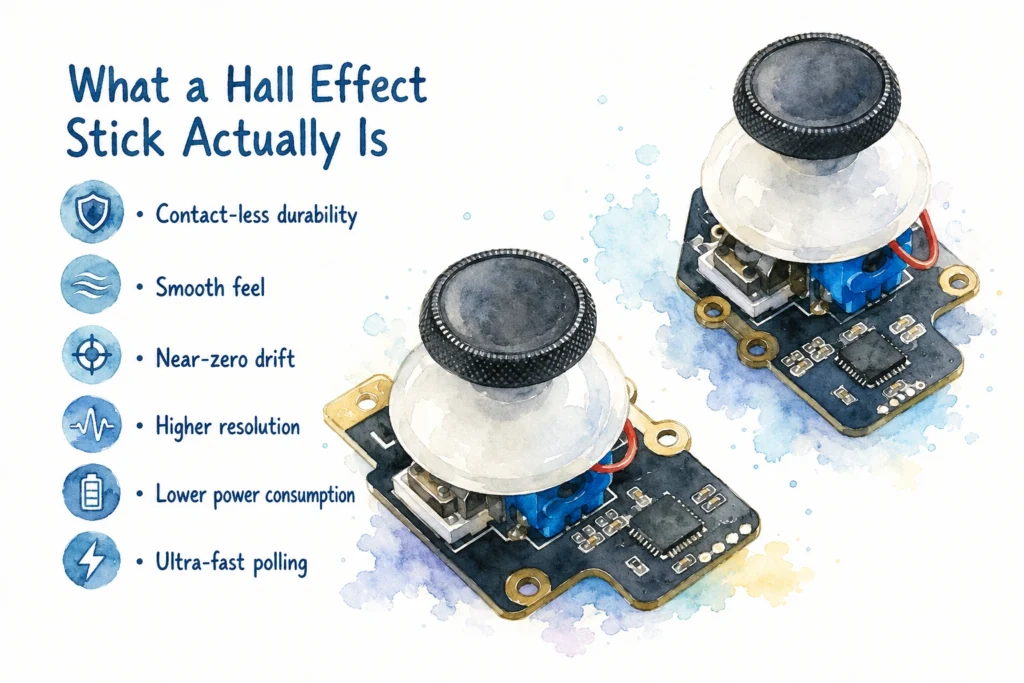
A Hall effect stick works completely differently, and this difference is the whole reason people claim it lasts longer. Instead of physical contact, it uses magnets and a sensor that detects magnetic field changes without anything actually touching.
Here is how it works in simple terms:
- A small magnet sits attached to the stick’s moving mechanism
- A sensor chip sits nearby, but does not physically touch the magnet
- When the stick moves, the magnet’s position relative to the sensor changes
- The sensor detects this change in the magnetic field and calculates exact stick position
| Part of the Process | What Happens |
|---|---|
| Stick movement | Moves a small magnet attached to the mechanism |
| Magnetic field change | Sensor detects the shift without any physical contact |
| Signal processing | Sensor chip converts field data into position data |
| Signal sent to console | Console interprets this the same way as any other stick input |
Since there is no physical rubbing between parts, there is fundamentally less mechanical wear happening every time you move the stick.
The Core Difference That Actually Matters
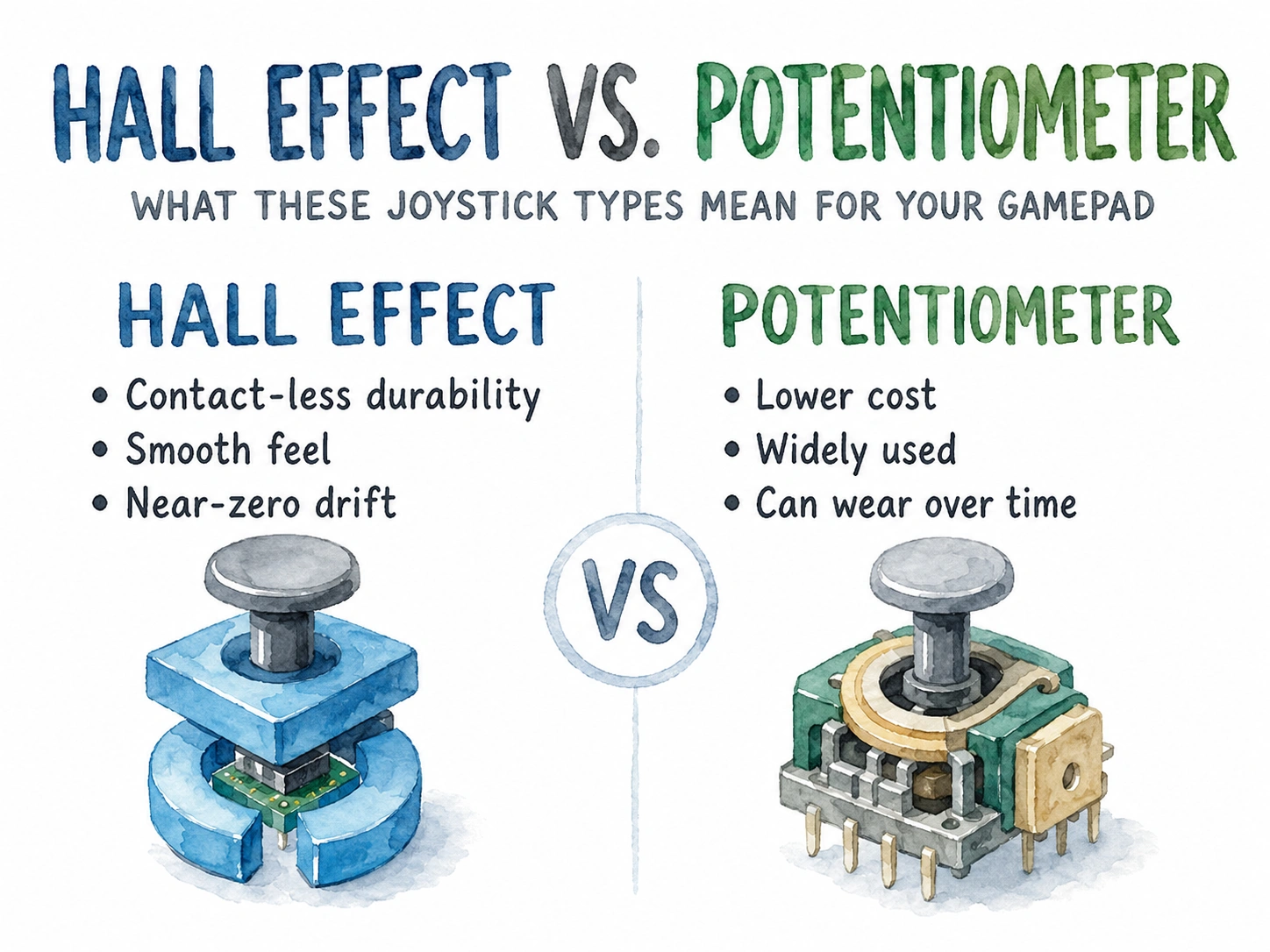
The entire debate comes down to one simple fact: contact wear versus no contact wear.
| Feature | Potentiometer Stick | Hall Effect Stick |
|---|---|---|
| Physical contact between parts | Yes, constant | No, contactless |
| Main wear mechanism | Friction from repeated rubbing | Almost none, no rubbing involved |
| Typical drift risk over time | Higher, increases with usage | Much lower |
| Manufacturing cost | Generally cheaper | Generally more expensive |
| Common in which controllers | Most standard Xbox, PlayStation, Switch controllers | Newer premium and some third party controllers |
A hardware engineer who has worked on controller design explained it simply: potentiometers are like an old fashioned volume knob that eventually gets scratchy from years of turning, while Hall effect sensors are like a contactless card reader, nothing physically rubs together, so nothing physically wears down in the same way.
Why Potentiometers Are Still So Common Despite This Weakness
If Hall effect sticks are clearly more durable, a fair question is why most major controllers still use potentiometers at all.
Reasons Potentiometers Remain Widely Used
- They cost significantly less to manufacture at massive scale
- The technology is extremely well understood and easy to produce consistently
- For many casual players, the lifespan is still long enough before drift becomes a real problem
- Replacement parts and repair knowledge are widely available and cheap
| Factor | Potentiometer Advantage |
|---|---|
| Manufacturing cost | Much cheaper per unit |
| Repair part availability | Extremely common and cheap |
| Production scale | Easier to manufacture in huge volumes |
| Consumer price impact | Keeps overall controller prices lower |
Major console makers producing tens of millions of controllers a year have strong financial reasons to stick with the cheaper, well established part, even knowing it wears out faster than the alternative.
How Much Longer Do Hall Effect Sticks Actually Last
There is no single universal number that applies to every controller, since build quality, usage habits, and environment all play a role. But based on repair shop data and manufacturer claims, the general pattern holds up clearly.
| Stick Type | Typical Reported Lifespan Before Drift Risk Increases |
|---|---|
| Standard potentiometer stick | Roughly eight months to two years for regular daily players |
| Hall effect stick | Often several years, with many users reporting no drift at all even after heavy use |
A technician who repairs controllers regularly mentioned that Hall effect equipped controllers make up a noticeably smaller share of the drift related repairs coming through the shop, compared to how common standard potentiometer drift repairs are.
Are Hall Effect Sticks Completely Immune to Drift?
No, and this is an important point people often get wrong. Hall effect sticks dramatically reduce the most common cause of drift, which is mechanical wear from contact, but they are not magically immune to every possible problem.
Ways Hall Effect Sticks Can Still Develop Issues
- Dust or debris can still physically interfere with the stick’s movement mechanism itself, even if the sensor part has no contact wear
- A manufacturing defect in the sensor chip itself can still cause reading errors, though this is less common
- Extreme magnetic interference from a very strong nearby magnet could theoretically distort readings, though this is genuinely rare in normal use
- Physical damage from drops or impacts can misalign the magnet relative to the sensor
| Issue Type | Applies to Hall Effect | Applies to Potentiometer |
|---|---|---|
| Wear from contact friction | No | Yes, main cause |
| Dust interfering with mechanical movement | Yes, still possible | Yes |
| Manufacturing defect | Rare, but possible | Rare, but possible |
| Physical impact damage | Yes | Yes |
So while Hall effect technology solves the single biggest cause of drift, it does not make a controller completely bulletproof against every other possible failure.
Which Controllers Actually Use Hall Effect Sticks
Not every controller on the market uses this technology, and it is worth checking specifically before assuming a controller has it just because it is expensive or well reviewed.
| Controller Category | Typical Stick Technology |
|---|---|
| Official Xbox controllers | Mostly potentiometer, some newer premium models vary |
| Official PS5 DualSense | Potentiometer |
| Official Switch Joy Cons | Potentiometer |
| Many premium third party controllers | Often Hall effect, marketed specifically as a feature |
| Budget generic controllers | Almost always potentiometer |
If avoiding drift long term is your main priority, checking a controller’s specific product listing or description for the words “Hall effect” before buying is the most direct way to confirm which technology it actually uses, since official first party controllers from major console makers have been slower to adopt it compared to third party accessory brands.
Testing Your Own Controller to Check Stick Health
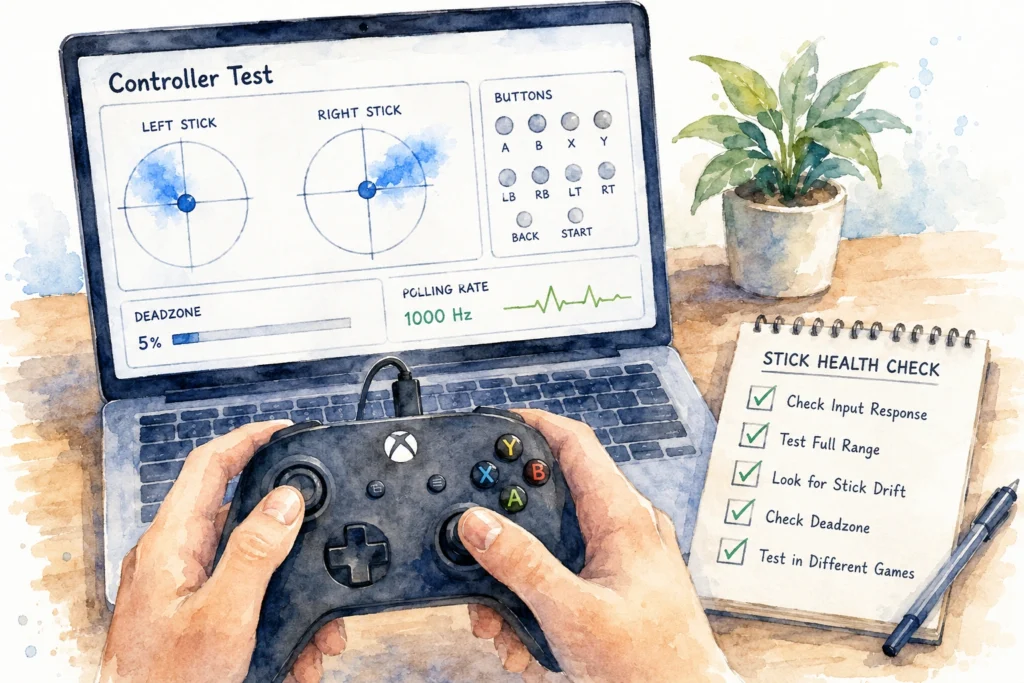
Regardless of which technology your controller uses, testing regularly helps you catch problems early before they become severe enough to affect gameplay.
Steps for a Proper Check Using a Gamepad Tester
- Connect your controller to a PC and open a browser based gamepad tester.
- Leave the stick completely untouched and watch for any movement on the on-screen indicator.
- Move the stick in slow full circles, checking that it traces a smooth complete circle.
- Push to each of the eight main directions and confirm full range is reached cleanly.
- Release from each direction and confirm the stick snaps back to true center immediately.
Browser-based controller tools access stick axis positions and button data through the Gamepad API.
| Test Result | What It Suggests |
|---|---|
| Dot stays still at rest | Stick is currently healthy |
| Dot drifts slowly on its own | Early or active drift, regardless of stick technology |
| Dot does not reach full range | Reduced sensitivity, worth monitoring |
| Dot snaps back cleanly after release | Good centering behavior |
Testing periodically, maybe every couple of months, applies the same way whether you own a potentiometer or Hall effect controller, since catching problems early always makes any eventual fix easier.
You can also use a deadzone tester to check whether the controller is ignoring too much or too little movement near the centre.
Cost Comparison Over Time
Looking only at the upfront price misses part of the picture, since a cheaper controller that needs repair or replacement sooner can end up costing more across a few years of ownership.
| Scenario | Potentiometer Controller | Hall Effect Controller |
|---|---|---|
| Upfront cost | Generally lower | Generally higher |
| Likely repair or replacement needed within two years of daily use | More likely | Less likely |
| Long term cost for heavy daily players | Can add up with repeated repairs or replacements | Often lower overall despite higher starting price |
| Long term cost for casual players | Often fine, may never need repair | Less relevant, since drift risk is already low with light use |
For someone who games a few hours a week casually, the difference in real world outcome may end up being fairly small. For someone who games for many hours daily, the gap becomes much more meaningful over a couple of years.
Common Misconceptions About These Two Technologies
A few myths get repeated often enough that they are worth clearing up directly.
- Hall effect sticks are not automatically more precise for aiming, precision depends on the whole sensor and software calibration, not just the underlying technology type
- Potentiometer sticks are not inherently bad or low quality, they have simply been the industry standard for decades and work fine for many players
- Not every controller marketed as “premium” actually includes Hall effect sticks, always check the actual product description rather than assuming based on price alone
- Hall effect technology does not prevent every possible controller problem, only the specific contact wear issue that causes most drift cases
A Simple Decision Table for Choosing Between Them
| Your Situation | Better Fit |
|---|---|
| You play casually a few hours a week | Either type works fine, potentiometer saves money |
| You play many hours daily in competitive games | Hall effect likely worth the extra cost |
| You have already dealt with drift multiple times before | Hall effect worth considering strongly |
| Budget is the main concern | Potentiometer controllers remain cheaper |
| You want the lowest long term chance of drift | Hall effect is the clear choice |
Frequently Asked Questions
Can I Upgrade My Existing Controller From Potentiometer to Hall Effect Sticks?
In some cases yes, since aftermarket Hall effect replacement modules exist for certain popular controllers, though installation typically requires opening the controller and some comfort with small electronics repair.
A model-specific controller repair guide can help you check the required tools and difficulty before opening a controller.
Do Hall Effect Sticks Feel Different to Use Compared to Potentiometer Sticks?
Most players report they feel very similar in day to day use, since the actual stick movement mechanism on top is usually the same, only the internal sensing method differs.
Is Hall Effect Technology New, or Has It Been Around a While?
The underlying technology itself has existed for a long time and is used in many industries beyond gaming, but its use in gaming controllers specifically has become more common only in recent years.
Do Hall Effect Sticks Cost More to Repair If Something Does Go Wrong?
Generally the sensor components themselves can be pricier than a basic potentiometer, though since they fail less often, actual repair frequency tends to be lower overall.
Does Every Premium Controller Brand Use Hall Effect Sticks Now?
No, adoption varies a lot even among premium third party brands, so checking the specific product details remains the only reliable way to know for certain.
Can Dust and Dirt Still Cause Problems With Hall Effect Controllers?
Yes, dust can still interfere with the physical movement of the stick mechanism itself, even though it does not cause the same kind of electrical contact wear that affects potentiometers.
Will Hall Effect Sticks Eventually Become the Standard in All Controllers?
Costs for this technology have been gradually decreasing, and more brands include it every year, though official first party console controllers have been slower to switch compared to third party accessory makers.